
Ah yes, another monk who fights like Bruce Lee or a Shao Lin monk, at least until they get hit at level two and fall like a sack of bricks. How original. Another flirty bard trying to seduce the room with lute and song. Haven’t seen that before (don’t get me wrong – love the conventional bard more than probably any other class, but hardly original). A Rogue who is a kleptomaniac, the gruff lone wolf Ranger begrudgingly coming in from the wilds, some tropes are so common that those who have never come within a mile of a D&D game know them.
But what if you want to play a class but add some flavor, some twists to the conventional 5th Edition build, something that maybe gets laughs or creates roleplaying options – or images that really eat up the scenery in the theater of the mind, you have come to the right place!

#1: My Monk Is A Sumo Wrestler
Why be Bruce Lee when you can be E. Honda? Being a monk brings up many images of Shaolin temples, kung fu, karate, a supernatural level of Bruce Lee style abilities in combat. And all of that is fine, but if you want a monk that can really add some incredible flavor and huge laughs to the table (especially with a capable storyteller at DM) then go the sumo wrestler route.
The description of a 400 or 500 lb character suddenly dashing 80 or 100 feet to close the distance and the incredible reactions from players and NPCs at that immediately creates an image you just don’t see every day – even with your most creative DnD groups. This is why this is one of my favorite ideas for an unconventional build because honestly you’re not changing much from playing a regular monk – other than maybe taking a chance with slightly lower Constitution or Wisdom to bump up Strength.
Sumo is a hand-to-hand combat art, and gives you a reason to look at the 5E grappler feat in addition to building a Monk with Strength and not just Dexterity, this allows you to have a monk who is strong, centered, and can move, and if you have a really good DM – they are going to go all in on helping you with pros and cons of this build to make it funnier.
Have some fun with this with the DM. Agree to need to eat 3x to 5x the rations, but maybe get a free slight Strength boost for that, or create a backstory with the bard of the group who is huffy because your food bills are making his free lodge/meal benefit something that has to be rolled for since word has spread. Maybe seeing your sumo move at double speed forces certain enemies to roll a fear check because, to borrow a line about Space Marines from Warhammer 40K, “Nothing that size should move that fast.”
There are many fun ways to incorporate the moves of a Sumo vs a conventional martial artist, can create funny moments when trying to hide from searches (oh those perception checks vs passive perception!) as it’s going to be harder for the big man to hide in an area with few hiding spots…but it should potentially make those intimidation checks better.
There’s a lot to play with here and if you have a DM that’s game – why not go for it?
Considerations: Getting the most out of this odd build and still being effective means you need to roll out your butt for stats since you really want four stats (STR, DEX, WIS, CON) or need to look for items that allow you to cheat on one. Gauntlets of Ogre Strength are a fantastic example as they shoot that Strength score up to 19 and allow you to focus on the more conventional monk stats that add to your unarmed AC and ability to make saves or use special abilities.
Also consider a Tabaxi. You add claws for unarmed strengths, and get extra climbing and movement potential in addition to painting the image of being a very, very fat cat who somehow can MOVE.

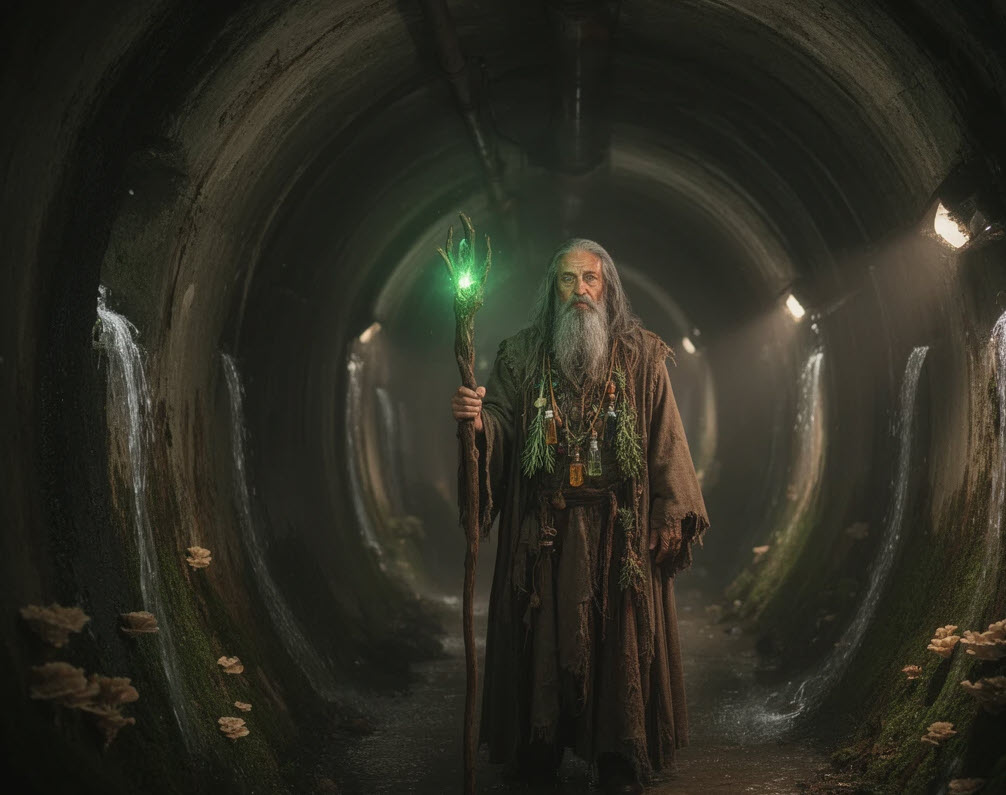
#2: The Druid of the City Sewers
While writing one of my fantasy adventure stories I’m hoping to eventually turn into a published novel, the protagonist Tara finds herself running from pursuers in the slums of a capital city, forced out of her element to deliver an important message. She is a Daughter of Gaia (Druid is a fair equivalent D&D comparison) and calls out to the ecosystems that form within the parks, slums, and sewer tunnels of the city itself, getting answers from packs of feral street cats, large swarms of rats, and hungry street dogs.
This brought some thought to me: I’ve never seen someone play a Druid whose focus was urban. Imagine a Druid understanding there is an entire sewer ecosystem within a city, one who understands and can feel when a city’s underbelly is sick, infected, strange. It can lead to strange exploration, a really different flavor of Druid, and maybe even clashes with the more conventional types of Druids.
How dare they talk about destroying a city when there’s a vibrant series of tunnels and underground sewers, dungeons, and paths that need the city to survive! They know the rats, the alley cats, the urban foxes who like to mess with guard dogs – all of it.
It’s not uncommon to have Druids living in harmony with wood elves or see them as inherently uncomfortable inside of a city, but to have a Druid who doesn’t really know what’s going on in the woods but can track brigands through an underground catacomb system or feel the unnatural flow of energy through a city park or series of back alleys?
Someone who might now about that underground rift to the Fey Realm that makes a lower level of tunnels an incredibly unique ecosystem, or feed swarms of rats who would be open game to all the falcons and hawks in the area without the alleys and human structures. Point being – there are possibilities here.
Considerations: Making this work to full effect will require working with the DM to brainstorm ideas for what you should know or understand, what interesting practices your Druid might have, or how they travel about through an urban “natural” ecosystem like city parks or tunnels and how that might come into play during a game. What enemies might the Druid have an actual non-antagonistic relationship with, what fights might they refuse, or what happens when they come into a clash with a more “traditional” Druid?
There are some serious potential options here, and in a campaign that is going to be based in Waterdeep or multiple cities, this is a very unique twist on one of the most stereotyped classes.
#3: A Mime Bard?
What if your bard wasn’t immediately boisterous, what if they had to do so many charisma checks that they might actually fail some because initial impressions are maybe…less than positive. How can you put a spin on a trope that just throws everyone at the table off – maybe forcing a description or a bit of really active role playing (stuck in a box = telling the wizard to cast wall of force?), and just prepping for an act involving your list of spells could lead to a fantastic session.
A mime bard would be one example – an entertaining not from smooth lines but from actions, from performance on the street, from their own form of interpretive dance? This could be a really interesting way to bring in a Kenku using a combination of miming and mimicked sounds to create a unique way of casting performative magic (see the “Off-Shoot” bard idea below for more on that path).
Or if a mime isn’t your thing, any type of bard that doesn’t go the conventional way of entertaining. Interpretive dance? Insult comic? Slapstick comedy? Deciding on a schtick that is off the beaten path provides tons of options – but it also is going to require a lot of prep each session so you’re prepared for whatever spells you might unleash or potential common situations where you can put on a silent act and steal the show.
And if you’re playing any type of a bard and you don’t have a long list of insults prepped for Vicious Mockery…what are you doing?
Considerations: Figuring out how you’re going to play a Mime Bard as a full-fledged character can be a challenge – especially since you want it to be a fully fleshed out character and not a thinly veiled schtick that is funny at first but gets old fast. Fortunately, a little bit of creative planning for spells, taking moments that happened in the campaign and spinning them in can keep this going. Role play the miming, then give them the interpretation, roll those performance rolls to see who gets the point, and embrace those natural 1’s where you somehow fail!

Off-Shoot: The Kenku Bard
Depending on how you play a Kenku character in DnD, this can be a great choice. Most Kenkus go straight to Rogue or Ranger, but the idea that a Kenku can have memorized soliloquies, switch from a gruff male Dwarven voice to an elegant elven lady’s voice in an instant can create some memorable scenes.
Like any Kenku character, the key here is going to be figuring out how to communicate and keep them fresh versus a tired rehash. One way I like to allow more variance with a Kenku is to assume all players know Common as sign language, because this allows you to really play with the sounds and mimicking while also giving a clear common lane to communicate with teammates that makes sense. In a world full of danger and adventurers, and dangers that require stealth to stay out of harm’s way, that some type of sign language would be commonplace.
In fact, you can argue it would be weirder that wouldn’t exist – and it opens up ways for a Kenku Bard to really thrive without being a one-note trope.
#4: The Cleric Killbot (aka, What’s a Heal Spell?)
Clerics are often seen as Heal Bots and for good reason: because if you want the top healing class, it’s 10 types of Clerics and maybe a Ranger or Druid if you have no Cleric, and they absolutely have to keep your party’s particular idiot monks or terrible rogues alive. Clerics are healbots. I mean, they have all the cure magic and what else exactly would they be?
Where this is where one of our great players and TTRPG veteran of 20+ years taught this (then) new DM that 5E made it possible for Clerics to not have to heal. I mean, why heal when you can use all your feats and spell slots to become a high AC moving blender that just tosses down damage all around you while you paralyze opponents, forcing them to continue to take damage while desperately trying to hit you with an attack and/or move.
The Spells:
- Spirit Guardians
- Spiritual Weapon
The Feats:+
If you’re an experienced player, you’ve already put together how nasty this is. For those of you not quite that geeked out into 5E – I’ll be happy to explain. The first piece is Spirit Guardians, which is the main blender. It creates a 15 foot sphere around you that starts at 3d8 damage and scales up with each level higher, but that’s just the beginning. Affected creatures can only move half speed in the area. When they enter it, they must make a Wisdom saving throw or take full damage. Even if they succeed – they’re still at half speed and take half damage.
The same Wisdom saving throw happens when they start it’s turn in the sphere.
And that’s where this gets really evil.
Because you still get to move full speed. With the polearm master and sentinel combination, when you hit your opponent their movement falls to zero. Meaning they must start their next turn in the blender sphere of death. This also means for at least once per round when an enemy is in reach, as a reaction you can hit them with an attack of opportunity.
Which with those feats will put their movement speed to 0, forcing them to stay in the sphere.
The Spirit Guardians spell only takes one action, lasts ten minutes, and then since you’re concentrating you still have your bonus action and future actions to do as you will. Cast Spiritual Weapon and every turn you can use a bonus action to attack with that.
This becomes a living nightmare for a DM – especially if your party has fighters, barbarians, and monks who can move with impunity while you blender anyone who comes near your group.
The Cleric Blender – tested and a living nightmare for DMs. We approve. Oh and War Caster makes it easy to keep the concentration up on the rare occasions someone does get to take a shot at you or an enemy wizard lobs a fireball to try to distract you.
Considerations: In our group we go by the mantra “Stay alive, scrub,” in a only half-way joking manner, and while having your Paladin Lay on Hands one hit point at a time on unconscious team members to keep them from dying while saying this line is great, you generally want some heals in the party. This doesn’t disqualify the build, but it does mean you’ll want a back up like a Druid, Bard, or Ranger for when you’re caught in combat and someone goes down.
#5: My Wizard Is Armored
This isn’t quite as strange as when 5E was first rolled out since there are specialist sub-class of wizards that are designed to work in such a crazy way as to create an enormously high AC – and they can be a lot of fun to play. But this is generally done through Dexterity, Sub-Class features, and more. In other words, this was more of a creative workaround with the original 2014 5E rules, but it’s still a great build that uses one creative loophole and the advantage of a good roll from the “rolling for stats” style that allows you to only need one really good roll and you can ignore having to min-max or go a conventional route to make it work.
If you’re playing by the original 2014 5E rules, and you like to think out the box, you probably understand that 1) Wizards can’t wear armor because of their class and 2) There’s exactly one race that gets Medium Armor proficiency as a racial ability, not a class ability.
That’s the Mountain Dwarf, which also gets +4 in starting abilities instead of the more common +3, but they are +2 STR and +2 CON…generally what you give fighters and barbarians, not wizards.
But that’s also the beauty of this build: because it goes right into roleplaying. For me a mountain dwarf wearing a kilt and an AC of 17 doesn’t scream wizard, but he might yell a line like “Stupid snobby wizards can’t even wear leather or take an axe to the face!” when explaining to new companions why he can’t drink in the wizards’ bar anymore.
You really only need to roll one good stat roll for INT as a wizard. A 14 for Dex is more than enough – and CON isn’t bad since it gives you more hit points to buffer those paltry d6 hit die rolls. Then throw on some half plate medium armor for a 17 AC with your modest Dex and decide how to roleplay the oddest looking wizard you’d find anywhere. If you can throw a Shield spell as a reaction for a +5 boost to 22 and you have a fully legal basic 5E armored wizard who is going to be very, very hard to hit at low levels.
And a strong wizard with a healthy constitution who can still cast all the spells? That can be a lot of fun to play because a bookworm by Dwarven trope standards might look very different indeed!
And with that AC and CON, he is likely to be more than capable of taking an axe to the face and walking away from the smoldering corpses of his enemies post-fireball.
Considerations: The better your starting roll for stats the better this works. Since you’ll want to put your highest number in Int, but keeping up the role playing means with Mountain Dwarf bonuses if you can add to STR and CON on top of that – it becomes a really interesting build that can be a lot of fun to play with. Is he an outcast? Does he take spells to try to act more frontline or use slight of hand to try to hide a catapult spell even as he swings his axe while in battle?
There’s a lot of potential fun here to play a very different type of wizard, the likes of which most groups are unlikely to see again. We talked a little bit about this in an old Unqualified Experts video.
What’s Your Favorite Unconventional D&D Build?
I’m always fascinated when someone comes up with a build that is just so different from what the table is expecting or something out of left field that I’ve never heard of. Especially when the build is off the beaten path from the most common trope of what that class does in a conventional party. That’s not to throw shade at the conventional healing Cleric or the charismatic AF bard – it’s a delight to see them played and played well.
But sometimes you just want to see something different, and when that is done very different and very well, it’s a delight to see. Whether 5E, DnD One, or the new 5E 2025 – what’s your favorite unconventional build? What are some of the wildest combos you’ve seen that worked…or didn’t but were fun for different reasons?
We’d love to hear about it, or how you put your own spin on one of these to give it a try!
Other DnD Articles You May Enjoy
- 5E DnD Complete Conditions Guide
- Best 5E Feats for Druids Guide
- Pathfinder Charismatic Barbarian Krok the Phisosopher
- How to Choose the Right Weapon for Your DnD Character

Proud to embrace the locally created moniker of “Corrupt Overlord” from one of the all time great Lords of Waterdeep runs, Shane is one member of the Assorted Meeples crew and will be hard at work creating awesome content for the website. He is a long-time player of board games, one time semi-professional poker player, and tends to run to the quirky or RPG side of things when it comes to playing video games. He loves tabletop roleplaying systems like Dungeons & Dragons, Pathfinder, Werewolf, Fate, and others, and not only has been a player but has run games as DM for years. You can find his other work in publications like Level Skip or Hobby Lark.